Article
How to choose an embedded systems internship in India: a checklist
By CAEE Engineering Team · Updated 6 Nov 2026 · 4 min read
A checklist for B.Tech and M.Tech students: what to ask before you join an embedded internship, the red flags, and the evidence you should finish with.
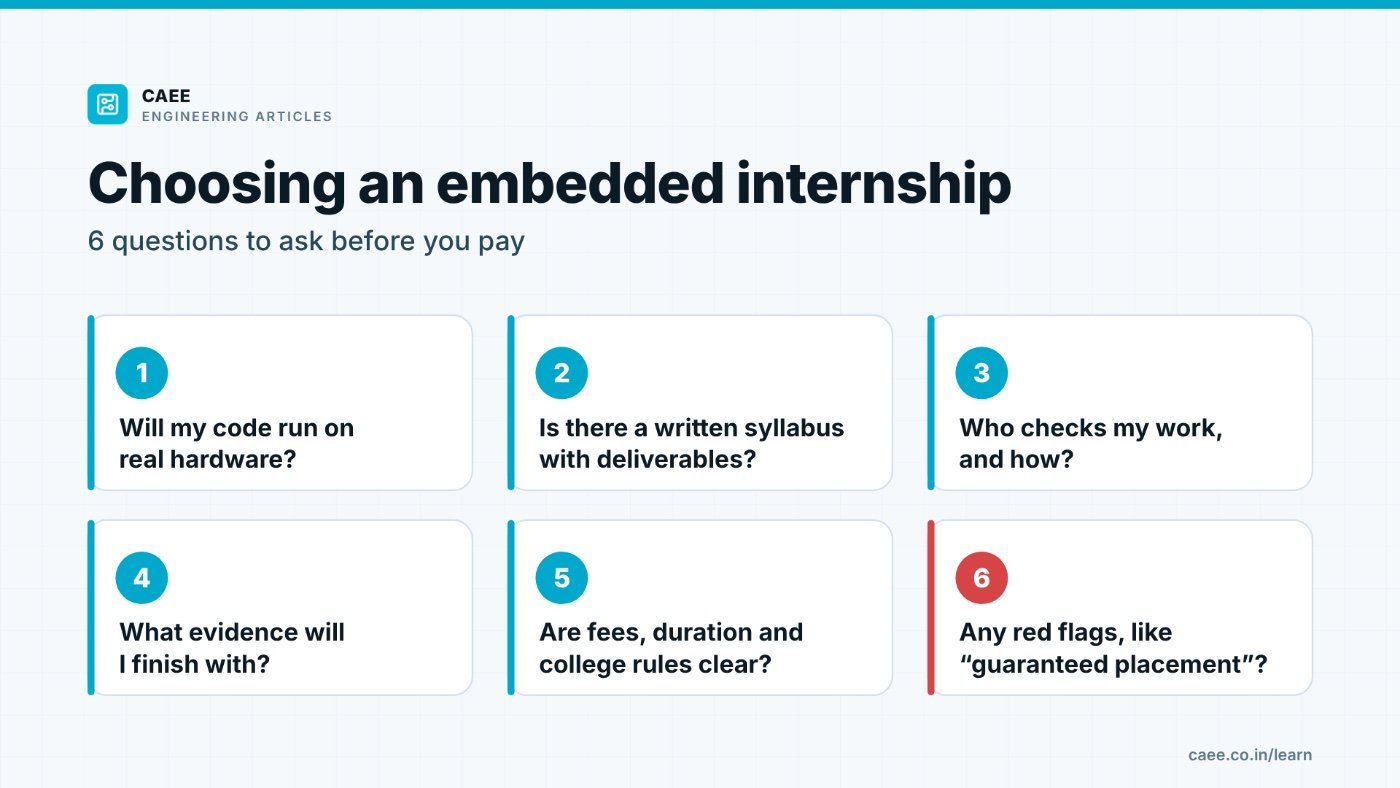
Short answer: choose the internship where your own code runs on real hardware, gets checked, and leaves you with evidence an employer can inspect: source code, test logs, a short report for each project and a certificate they can verify. A certificate on its own proves very little.
Use the six questions below on any programme you are considering — including ours.
1. Will your code run on real hardware?
Embedded engineering is software that controls hardware, so the hardware is not optional. Ask:
- Which microcontroller and board will I program? A named part, such as an STM32 NUCLEO board, is a good sign. "Embedded concepts" with no board is not.
- Is my code flashed to that hardware and run? How is the result checked?
- If the internship is online, how do I get hardware: a board shipped to me, a simulator, or a remote lab?
Simulators are useful for learning, but some skills only come from real hardware: reading an oscilloscope trace, finding a bus error, meeting a timing deadline.
2. Is there a written syllabus with deliverables?
Ask for the module list and the project list before you pay. Good signs:
- Each module ends with something you build and submit.
- Each project has a clear "what to submit" list.
- The syllabus names peripherals and protocols — timers, ADC, interrupts, UART, I²C, SPI, CAN — instead of buzzwords.
3. Who checks your work, and how?
Automatic checks catch build errors and wrong outputs quickly. A review by an engineer catches design problems that tests miss. Ask who reviews your work, how soon you get feedback, and what that feedback looks like.
4. What will you finish with?
In interviews you will be asked to explain your own code. Aim to leave with:
- A repository of the code you wrote.
- Test logs, bus traces or plots that show it working.
- A short report for each project: the problem, your design, your results.
- A certificate with an ID that an employer can verify.
5. Are the fees, duration and college requirements clear?
- Total fee, what it includes, any extra hardware cost, and the refund policy.
- Duration and the weekly time you are expected to put in.
- Many "internships" in India are paid training programmes: you pay a fee for structured training and mentoring. That can be worth it if the training is real. Compare what you get for the fee, not the label.
- If you need the internship for college credit, ask your department or training and placement officer what they accept — hours, offer letter, completion certificate, report format — before you join.
6. Watch for red flags
- A promise that you will be placed in a job. No training provider controls a company's hiring decision.
- A certificate without assessed work.
- No syllabus, no named hardware, no sample project.
- An organisation you cannot identify. Look for a registered company name and an address. You can look up an Indian company's registration on the Ministry of Corporate Affairs (MCA) website.
- Pressure to pay immediately "before seats run out".
Skills that matter for automotive embedded roles
| Skill | Why it matters |
|---|---|
| Embedded C | Most microcontroller firmware is written in C. |
| Microcontroller peripherals | GPIO, timers, ADC, interrupts and DMA are the daily tools of firmware work. |
| CAN and CAN FD | The main network between a vehicle's ECUs (ISO 11898-1). |
| Debugging on hardware | Using a debugger, an oscilloscope or a logic analyser to find real faults. |
| Reading datasheets and reference manuals | Every register setting comes from them. |
| Git | Teams review and track code in version control. |
| MISRA C and ISO 26262 awareness | The coding guidelines and functional-safety standard used in many automotive projects. |
| RTOS basics | Tasks, priorities and timing in multi-tasking firmware. |
How CAEE answers these questions
You can check each point on the pages linked:
- Hardware: the CAN / CAN-FD Internship uses the STM32 NUCLEO-G474RE with an MCP2562FD CAN-FD transceiver; the FOC Motor Control Internship uses the NUCLEO-G474RE with the X-NUCLEO-IHM08M1 motor driver.
- Syllabus: every module and project, with what to submit, is listed on the track pages.
- Real hardware without buying a board: the Remote Hardware Lab runs your CAN firmware on real STM32 boards on a 500 kbit/s CAN bus, from your browser.
- Verifiable certificates: every certificate carries a unique ID that anyone can check on this site.
- Try before you pay: start with a free workshop.
Sources
- ISO 26262-1:2018 Road vehicles — Functional safety — Part 1: Vocabulary
- MISRA (Motor Industry Software Reliability Association), MISRA C guidelines
- Ministry of Corporate Affairs, Government of India (company master data)
- ISO 11898-1:2024 Road vehicles — Controller area network (CAN) — Part 1
All articles · CAN / CAN-FD Internship · FOC Motor Control Internship · Free workshops